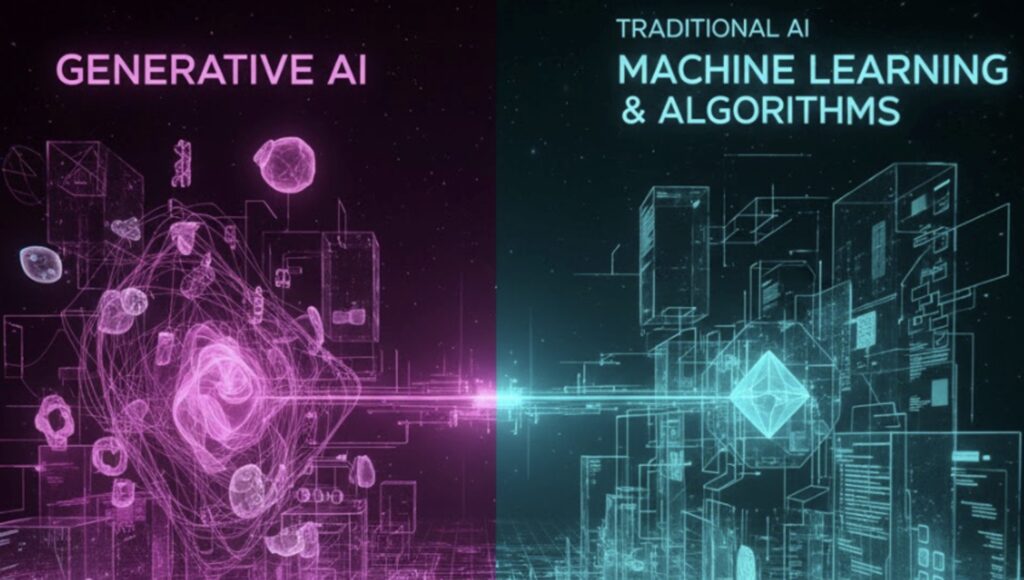
In the world of golf, there is a well-known adage: " drive for show, putt for dough." This saying underscores that while a long, spectacular tee shot impresses the audience, it is the precision on the green that truly defines the winner. Similarly, in the current technological landscape, we are witnessing the stellar rise of Inteligencia Artificial Generativa (GenAI), which, with its dazzling capacity to create and reason, has captured all the attention, offering us an undeniable "show." However, if the goal is to transform this attention into tangible results, strategic growth, and operational robustness—the true "dough" for our business—it is essential to recognize that the foundation of all success lies in traditional Artificial Intelligence, el Machine Learning (ML) y el Advanced Analytics. Este artículo explora cómo la GenAI brilla en el escenario público, mientras que el ML y el análisis avanzado, discretamente, proporcionan los datos estructurados, el contexto estratégico y los insights algorítmicos críticos, que no solo impulsan nuestros procesos de negocio, sino que también son la materia prima esencial para que los agentes de la GenAI, ya sean conversacionales (mediante RAGs sofisticados) o autónomos, cumplan sus promesas de innovación, mejora continua y crecimiento.
Traditional Artificial Intelligence, the kind that is fueled by Machine Learning and Advanced Analytics, is not a static technology; it is undergoing a silent and impactful revolution thanks to unprecedented computing power. Access to cloud computing infrastructure and advanced hardware has democratized processing power, allowing the execution of enormously complex and sophisticated algorithms on a gigantic volume of corporate data at astonishing speed and a reasonable cost.
The unprecedented calculation accuracy is the direct result of this capacity for massive data ingestion and processing, built upon years of corporate history. By feeding Machine Learning models with the complete context of an organization's past interactions, transactions, and outcomes, AI manages to unravel subtle and complex behavioral patterns that remained undetectable to human analysis or traditional statistics. The impact of this algorithmic mastery is materialized in the hyper-relevance of content, products, and services that companies offer us, adapted microscopically to our individual needs.
Concrete examples illustrate the criticality of this volume-based precision:
- The Supply Chain Optimization can now predict product demand with an accuracy that minimizes excess stock (drastically reducing storage costs) while simultaneously avoiding feared stock outs (maximizing sales).
- The Hyper-Segmented Personalization transcends simple recommendation, integrating the entirety of the customer's history: from web browsing and in-store purchases to post-sale interactions or complaints.
- The Fraud Detection elevates its effectiveness by cross-referencing current activity with billions of past transactions, both legitimate and fraudulent, securing assets with a minimal rate of false positives.
- The Predictive Maintenance in industrial environments, through constant analysis of sensor data (vibration, temperature, performance), allows for high-fidelity forecasting of the exact moment a critical component will fail.
Collectively, these cases demonstrate convincingly how the deep mining of large volumes of data is not an option, but the foundation that grants AI the ability to make highly accurate decisions, essential for competitive advantage.
Similarly, processing speed has broken the time barrier, enabling real-time decision-making (RTDM). This means that recommendations, preventive actions, or personalized offers are executed with an information window that includes both the transactional data from one second ago and the trend from the last decade, combining immediacy with deep historical knowledge.
Concrete examples illustrate the criticality of speed-based real-time decision-making:
- The Content, Product, or Service Recommendation in the face of indecision or potential abandonment by a user who browses a product page, adds an item to the cart, and then halts their activity. Responding instantly (in milliseconds), the system triggers an immediate offer, such as a personalized shipping discount or a complementary product recommendation, preventing the loss of the sale at the critical moment.
- The Dynamic Pricing Optimization in sectors with limited inventory or high volatility (airlines, hotels, ticket sales, or perishable products). The system adjusts prices in real-time, simultaneously maximizing revenue and customer satisfaction by basing the price on live demand, current supply, competitors' prices, and recent sales history.
- The Credit Limit Control and Fraud Alert for continuous transactional monitoring. If a customer makes a purchase that exceeds a habitual spending pattern, the system does not wait until the end of the day. It compares that transaction in real-time with millions of known fraud patterns. If a risk is detected, the card can be blocked or an immediate authentication can be requested from the customer in under a second, minimizing the financial risk exposure.
The cost-efficiency factor is the great enabler: this power is no longer an exclusive privilege of large corporations. Today, any company can leverage AI to propose deeply personalized content, products, and services, which directly translates into greater customer satisfaction and a significant reduction in the churn rate, strengthening the business fabric as a whole.
Conclusion
La era de la Inteligencia Artificial exige un cambio de enfoque: la GenAI es nuestra herramienta de execution, interface, and creativity tool, but traditional Artificial Intelligence is the traditional Artificial Intelligence infrastructure of truth, context, and intelligence. . To reap the dough en forma de crecimiento de facturación, eficiencia operativa y gestión de riesgos —lo que en golf sería el putt certero—, las organizaciones deben seguir invirtiendo en la potencia de su Machine Learning y su Advanced Analytics. Sin la base de datos precisos y en tiempo real que ofrece el ML, el deslumbrante potencial de la GenAI se reduce a una herramienta de comunicación sin contexto sofisticado. La estrategia ganadora reside en la symbiosis: utilizar la precisión y velocidad del ML como el cerebro que informa, verifica y dirige la voz creativa y autónoma de la GenAI.